For years, the last week of every month felt the same: I’d look at my account, see far less than I expected, and have no real idea where it had gone. Not on anything dramatic — just a steady leak of small, forgettable spends that added up to a number that made me wince. I wasn’t broke and I wasn’t reckless. I was just flying blind, making money decisions on a vague feeling instead of a clear picture. The Personal Finance template is what finally gave me that picture, and the first month I used it properly, I genuinely found money I didn’t know I was wasting. Here’s how it works.
Why “I’ll just be careful” never works
Budgeting fails for most people not because they overspend wildly, but because they can’t see their spending at all. Money comes in from a salary or a side hustle, goes out across dozens of tiny transactions, and the only feedback you get is the dwindling balance at the end. By then it’s too late to change anything.
“I’ll just be more careful next month” is a plan with no information behind it. Careful about what? You can’t fix a leak you can’t locate. And the paid finance apps that promise to fix this come with subscriptions, bank logins you’re not always comfortable with, and a feeling that your data lives somewhere it shouldn’t.
What actually changes behaviour is plain visibility: where money comes from, where it goes, and which categories quietly eat the most — all somewhere private that you control.
What’s inside the Personal Finance template
It’s a full budgeting system built from a few clean, connected databases rather than one cluttered table, so income and spending never blur together.
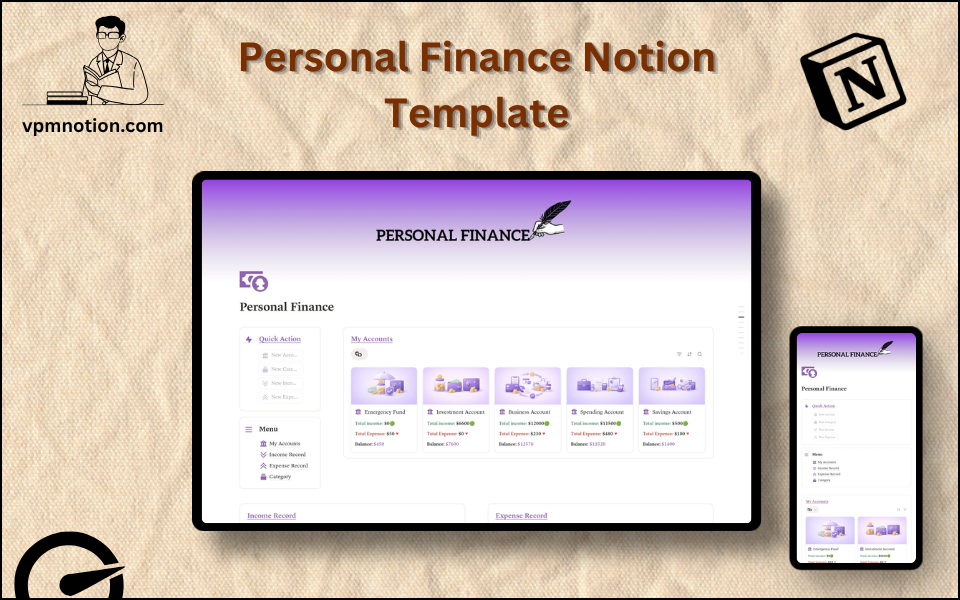
There’s a My Accounts database for every account and its balance, an Income Record for everything coming in (source, amount, date, category), an Expense Record for everything going out (description, amount, category, payment method), and a Category database where you set monthly budget limits per type of spending. Tying it together is a This Month Record view that filters everything down to the current month, so you get an instant read on your cash flow without doing any maths.
Four Quick Action buttons sit up top to log income, an expense, an account, or a category in a couple of taps — and the speed matters, because a budget only works if logging is frictionless enough to actually do. It’s deliberately private: everything lives in your own Notion workspace, no bank connection, no subscription. If you want something lighter and even more stripped-back, a Notion financial tracker is the leaner cousin of this; and freelancers with variable income will want to pair it with a freelancer business system so business and personal money don’t tangle.
How I use it month to month
The whole thing rests on one small habit: logging an expense right after I spend, while it’s still in my hand. Ten seconds with a Quick Action button. Skip that and the records go stale; keep it and the picture stays honest.
At month end I open This Month Record and actually look — net cash flow, and which categories ran over. That five-minute review is where the behaviour change happens, because seeing “I spent that much on takeaways” does more than any willpower lecture. The categories I overspend on become the focus for next month, and bigger goals get their own treatment: saving for a trip lives next to my Notion travel planner, and recurring food spend ties to a foods and nutrition template when I want to bring grocery costs down deliberately.
What I’d tell anyone starting
Log expenses immediately, not weekly. A budget you update once a week from memory is a budget built on guesses.
Set real category limits, then check them mid-month, not just at the end — catching an overspend on the 15th still leaves you time to course-correct.
Keep it private and keep it simple; the best budget is the one you’ll actually maintain. If money is one of several habits you’re building, it sits nicely beside the routines in my student habit tracker and the wider planning in a student planner if you’re studying — and even gift spending gets calmer when birthdays are mapped out in a birthday tracker.
See your money clearly for once
You don’t need to earn more to feel more in control of your money. Usually you just need to see it — where it comes from, where it goes, and where it quietly leaks. That clarity, more than any rule, is what changes the end-of-month wince into a calm review.
If your money has a habit of vanishing without explanation, you can get the Personal Finance template here and finally see the whole picture — privately, in your own workspace.
What’s the spending category you suspect is your biggest quiet leak? Tell me in the comments.
Found this useful? Share it with someone who needs it.