I have a small graveyard of abandoned planners — paper ones gathering dust, digital ones I set up enthusiastically and opened maybe four times. For years I assumed the problem was me: not disciplined enough, not a “planner person.” Then I noticed something. Every system I’d quit had one thing in common: it was grim to look at. A grey, joyless grid I had no desire to open. The ones I almost stuck with were the pretty ones. It turns out that for me, and a lot of people, whether a planner is nice to open matters as much as what it does. So I built one that’s genuinely lovely, and for once I kept using it. Here’s how it works.
Why we abandon planners we meant to use
There’s a quiet truth about productivity tools that the productivity world tends to ignore: the best system is the one you’ll actually open, and aesthetics are a huge part of that. A planner you dread looking at gets avoided, and an avoided planner is no planner at all — it doesn’t matter how powerful it is if it’s gathering dust.
There’s a second, sneakier reason planners fail: the blank page. A beautiful empty weekly grid is intimidating, not inviting. Faced with structuring an entire week from scratch every Sunday, most people just don’t, and the planner quietly dies in its first month.
So the fixes are two: make it a place you want to be, and remove the blank-page paralysis by giving people a structure to start from. Get both right and a planner stops being a chore you abandon and becomes a habit you keep.
What’s inside the Aesthetic Weekly Planner
It leads with design on purpose, because that’s what gets you to open it — but underneath the calm, nature-inspired look is a genuinely complete planning system.
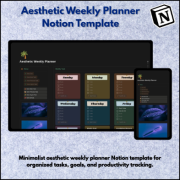
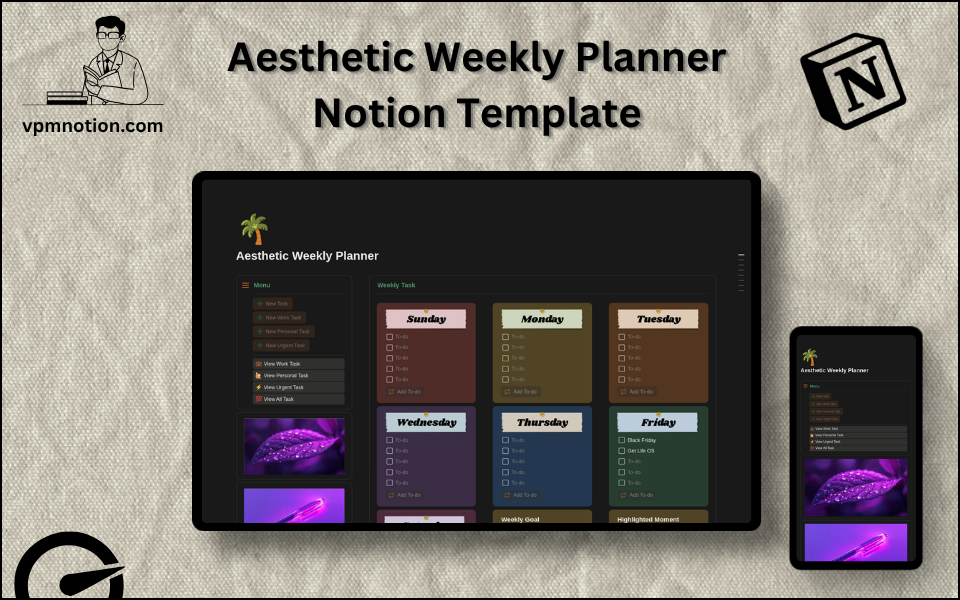
There are seven individually animated day sections, each with its own colour, so planning Monday feels distinct from planning Saturday. The piece that quietly solves the blank-page problem is a pre-filled, colour-coded weekly schedule table running from 5am to 9pm — realistic time blocks for waking, exercise, work, meals, and family time that you adjust rather than build from nothing. A Weekly Goal section up top and a Highlighted Moment section at the end bookend your week with intention and reflection.
Small living touches keep it feeling alive: a live clock, a progress bar that fills as you complete tasks, and a Routine Tracker for recurring habits. Four menu buttons make adding work, personal, or urgent tasks effortless. For deeper academic planning it pairs naturally with a full student planner, and the recurring routines you build here are tracked with real motivation in a habit tracker.
How I use it each week
My ritual is Sunday evening: I open the planner, set three priorities in the Weekly Goal section, and skim the schedule table to tweak the week ahead. Because the structure is already there, this takes ten calm minutes instead of the daunting hour a blank planner demands — and that low friction is precisely why I keep doing it.
Through the week I work from each day’s coloured section and watch the progress bar fill, which is sillier and more motivating than I’d like to admit. The daily habits running alongside link to my student habit tracker, I block wellness time that connects to my health and fitness tracker and meals to a foods and nutrition template, and the heavier task load lives in an advanced to-do list. At week’s end I fill in the Highlighted Moment, which doubles as a gratitude note and feeds into my daily journaling template.
What I’d tell a serial planner-abandoner
Pick a system you find genuinely nice to look at, and don’t feel silly about it. Aesthetics aren’t vanity here — they’re what gets you to open it, and opening it is the whole game.
Lean on the pre-filled schedule instead of starting blank. Adjusting a structure is easy; building one from nothing every week is what kills most planners.
Keep the Sunday goal-setting and the end-of-week reflection — those two small rituals are what turn a planner from a passive grid into something that actually shapes your week.
Plan a week you’ll look forward to
The most effective planner isn’t the most feature-packed; it’s the one you’ll keep opening. When a planner is calming to look at and gives you a structure to start from, weekly planning stops feeling like homework and starts feeling like a small, pleasant ritual — and that consistency is what actually changes how your weeks go.
If you’ve abandoned more planners than you’d like to admit, you can get the Aesthetic Weekly Planner here for free and try one you’ll actually want to open.
What made you quit your last planner? Tell me in the comments — I suspect I’ll relate.
Found this useful? Share it with someone who needs it.