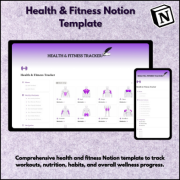
I trained pretty consistently for a few months once and had almost nothing to show for it — not because the effort wasn’t there, but because I had no idea whether I was actually getting stronger. Each session I’d grab whatever weight felt about right, do a vaguely familiar set of exercises, and leave. Ask me if I’d lifted more than the week before and I genuinely couldn’t tell you. I was working out, but I wasn’t training, and the difference is a record. Without one, you can’t apply the single most important principle in fitness: gradually doing a little more over time. The Health & Fitness Tracker is what I built to fix that, and it’s when my training finally started going somewhere. Here’s how it works.
Why training without tracking goes nowhere
Showing up at the gym feels like progress, and to be fair, it’s far better than not showing up. But effort without a record quietly caps how far you’ll get, because the engine of almost all physical progress — progressive overload — depends entirely on knowing what you did last time. Add a little weight, a rep, a set, week over week. You simply cannot do that from memory.
Relying on memory causes two problems. You drift, repeating roughly the same workout at roughly the same difficulty for months, wondering why nothing changes. And you train unevenly, hammering the muscle groups you enjoy and quietly neglecting the ones you don’t, because nothing’s showing you the imbalance. The result is a lot of honest effort producing disappointingly little.
What turns working out into training is a log: what you did, how much, how it felt — so each session can deliberately build on the last.
What’s inside the Health & Fitness Tracker
It’s a purpose-built training companion, structured around the two things that actually drive results: a record of what you’ve done and a plan for what’s next.
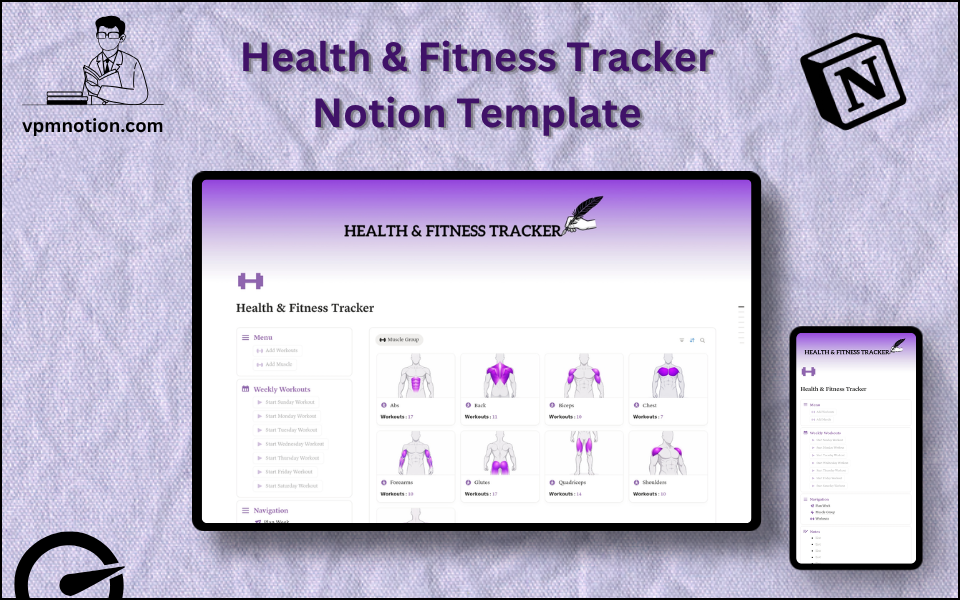
A Workout History database logs every session — date, type (strength, cardio, HIIT, yoga), muscle groups, duration, the exercises with sets, reps, and weight, plus how you felt and any personal records. That history is the thing that makes progressive overload possible, because you can always see exactly what to beat. An Exercise Library database becomes your own reference of movements, tagged by muscle group, equipment, and difficulty, with technique notes — so you stop relying on scattered fitness apps. And a Weekly Plan lets you assign workout types to each day before the week starts.
The day-to-day logging is frictionless: seven day-specific buttons (one per day of the week) let you log a session without navigating anywhere, and a Muscle Group view keeps your training balanced across a proper split. Notes and Tasks sections hold the wider context — injury notes, rest days, booking the gym. The habit of showing up is best reinforced in a habit tracker, and since training is only half the equation, it pairs directly with a foods and nutrition template for the diet side.
How I use it day to day
Before a session, I glance at last week’s entry for whatever I’m training, so I know exactly what to beat — one more rep, a little more weight. That single look is what makes each workout build on the last instead of just repeating it.
During training I log sets, reps, and weight as I go, plus a quick note on how it felt, which over time reveals patterns like which lifts stall when I’m under-slept. I plan the week’s split with the Muscle Group view so nothing gets neglected, fitting the sessions into my aesthetic weekly planner and folding the daily movement goal into my student habit tracker. Reflecting on energy and recovery in a daily journaling template helps me spot overtraining early, and I treat a bigger fitness goal as a project in a projects and tasks system. The books that shaped my training live in a books tracker.
What I’d tell anyone starting
Log every set, every session, even when it feels tedious. The record is the whole point — it’s what lets you progressively overload instead of drifting.
Check last week before this week. Beating your previous numbers is the simplest, most reliable way to keep improving, and it only takes a glance.
Use the Muscle Group view to train in balance, not just the exercises you enjoy. And remember the gym is only half of it — recovery and nutrition are where a lot of progress is actually made, which is why I never track training in isolation.
Train on purpose, not on vibes
Effort matters, but effort with a record matters far more. When you can see exactly what you did last time and deliberately do a little more, your workouts stop being a vague routine and start compounding into real strength. The log is the quiet difference between exercising and training.
If you’ve been putting in the work without seeing the results, you can get the Health & Fitness Tracker here for free and start training with a record behind you.
What’s the lift or goal you’re chasing right now? Tell me in the comments — and tell me your current numbers.
Found this useful? Share it with someone who needs it.